
Gaming Monitors

Gaming monitor guides covering refresh rate, resolution, OLED, ultrawide and value-focused options.

Quick buying guide

A practical starting point for gaming monitors

Typical UK price range: £100–£1,300+Indicative market guide reviewed August 2026. International pricing, tax, availability and subscriptions vary by region.

Match resolution and refresh rate to the graphics hardware you actually own. A fast 1440p display is often the sweet spot for PC gaming, while OLED raises contrast and response performance but costs more and needs sensible static-image care.

Common search themes:best gaming monitorbest budget gaming monitorOLED gaming monitor1440p 240Hz monitor4K gaming monitor
Products worth comparing

Shortlist at a glance

These are research-led starting points chosen to represent useful budgets and use cases. A product appearing here is not a claim that we have personally tested it; hands-on experience is labelled separately in detailed reviews.

Gaming Monitors shortlist comparison
Product / serviceOur shortlist roleIndicative priceBest for
ASUS TUF VG259Q5ABest budget 1080p£90–£120Entry gaming PCs and high-refresh 1080p
AOC Q27G4XFBest value 1440p£120–£160Balanced 27-inch PC gaming
Alienware AW2726DMBest budget OLED£330–£400OLED response and contrast at a lower entry price
Gigabyte MO34WQC2Best ultrawide OLED£650–£750Immersive 21:9 gaming and sim racing

Best budget 1080p

ASUS TUF VG259Q5A

Indicative price: £90–£120

Product-specific evidence · sources checked 25 August 2026

A value-focused 24.5-inch high-refresh IPS-class option for first gaming builds and competitive titles.

Best for: Entry gaming PCs and high-refresh 1080p

Potential drawback: 1080p is less sharp on larger desks

Research assessment

This is a focused budget esports display: 24.5-inch Full HD keeps GPU demands modest, while the Fast IPS panel and 200Hz refresh rate target high-frame-rate shooters. Independent testing and owner feedback support its smooth motion and respectable colour for the tier. The low price is achieved by trimming the surrounding experience—resolution is basic for work, HDR is nominal rather than impactful, the speakers are incidental and the stand lacks the full ergonomic adjustment found on better-equipped monitors.

Reasons to consider
  • Fast 200Hz IPS presentation at an accessible price
  • Sensible size and resolution for modest PCs chasing high frame rates
Limitations and checks
  • Full HD limits desktop sharpness and long-term versatility
  • Basic stand, speakers and HDR mean buyers may need an arm and separate audio
Sources and evidence notes (3)

This editorial synthesis does not represent a hands-on test by The Tools and Tech. Source links are references, not affiliate links. Research depth: Official product information plus multiple product-specific independent sources.

  1. ASUS VG259Q5A specifications (opens in a new tab) (manufacturer)
  2. Root-Nation VG259Q5A review (opens in a new tab) (independent review)
  3. PcComponentes VG259Q5A owner-review summary (opens in a new tab) (retailer owner feedback)

Price and availability can change. Check the retailer for the latest information.

Best value 1440p

AOC Q27G4XF

Indicative price: £120–£160

Product-specific evidence · sources checked 25 August 2026

A strong value route into 1440p high-refresh gaming without paying OLED money.

Best for: Balanced 27-inch PC gaming

Potential drawback: HDR is not the reason to buy it

Research assessment

The Q27G4XF concentrates its budget on the combination most mainstream PC gamers want: 27-inch QHD, Fast IPS and up to 180Hz. Published testing and large-scale owner feedback point to sharp everyday image quality, smooth adaptive-sync gaming and a genuinely useful adjustable stand. It should still be bought as an SDR monitor. Contrast and dark-room blacks are ordinary IPS, HDR10 acceptance does not create convincing HDR, and the single-HDMI/basic-connectivity approach is less suitable for a desk full of devices.

Reasons to consider
  • Strong QHD/180Hz value with a height-adjustable ergonomic stand
  • Good general colour and viewing angles for mixed gaming and work
Limitations and checks
  • Limited IPS contrast and only superficial HDR impact
  • Basic port selection and controls compared with more expensive displays
Sources and evidence notes (3)

This editorial synthesis does not represent a hands-on test by The Tools and Tech. Source links are references, not affiliate links. Research depth: Official product information plus multiple product-specific independent sources.

  1. AOC Q27G4XF specifications (opens in a new tab) (manufacturer)
  2. Technopat Q27G4XF measured review (opens in a new tab) (independent review)
  3. PcComponentes Q27G4XF owner-review summary (opens in a new tab) (retailer owner feedback)

Price and availability can change. Check the retailer for the latest information.

Best budget OLED

Alienware AW2726DM

Indicative price: £330–£400

Product-specific evidence · sources checked 25 August 2026

A 27-inch QD-OLED option that brings premium contrast and fast response into a more attainable price bracket.

Best for: OLED response and contrast at a lower entry price

Potential drawback: OLED care and static-content considerations still apply

Research assessment

The AW2726DM lowers the price of 27-inch 1440p QD-OLED by stripping away extras rather than the central gaming experience. Independent measurement supports excellent contrast, colour and 240Hz motion, and Dell includes an adjustable stand and three-year cover. The omissions matter outside gaming: there is no USB hub or USB-C, HDMI is limited to 1440p/120Hz, SDR brightness is modest and the older triangular sub-pixel structure can soften small desktop text. OLED-care habits remain sensible for static-heavy use.

Reasons to consider
  • Exceptional OLED contrast and fast 240Hz response for the price
  • Useful adjustable stand and three-year panel support
Limitations and checks
  • No USB-C, USB hub or premium connectivity, with HDMI capped below the panel refresh rate
  • Modest brightness, text-fringing risk and normal OLED static-content considerations
Sources and evidence notes (3)

This editorial synthesis does not represent a hands-on test by The Tools and Tech. Source links are references, not affiliate links. Research depth: Official product information plus multiple product-specific independent sources.

  1. Dell UK AW2726DM specifications (opens in a new tab) (manufacturer)
  2. Tom's Hardware AW2726DM measured review (opens in a new tab) (independent review)
  3. WIRED AW2726DM review (opens in a new tab) (independent review)

Price and availability can change. Check the retailer for the latest information.
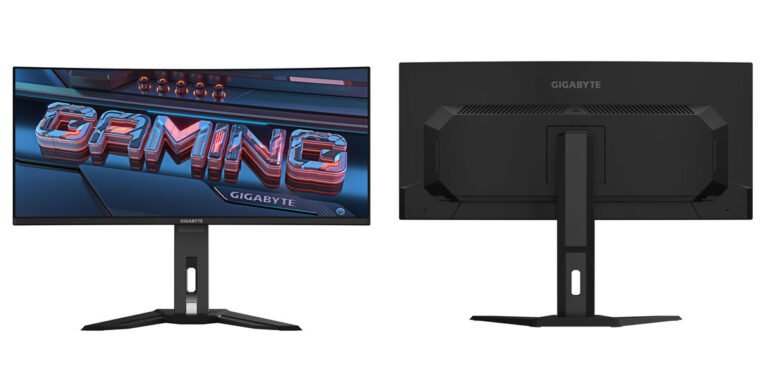
Best ultrawide OLED

Gigabyte MO34WQC2

Indicative price: £650–£750

Product-specific evidence · sources checked 25 August 2026

A 34-inch ultrawide OLED choice for buyers who want immersion, contrast and a wide field of view.

Best for: Immersive 21:9 gaming and sim racing

Potential drawback: Needs more GPU power and desk width

Research assessment

Gigabyte’s 34-inch QD-OLED combines the immersion of 3440×1440 ultrawide with the clarity and response of a 240Hz OLED panel. Independent measurements found exceptionally low lag, strong accuracy and a very wide colour gamut; the built-in KVM, USB-C input and full-height stand also make it more useful for a two-computer desk than many gaming-only rivals. It is expensive, needs substantial GPU performance and desk width, and its 18W USB-C power delivery is not enough to function as a one-cable laptop dock.

Reasons to consider
  • Outstanding motion, contrast and colour in an immersive 21:9 format
  • KVM, HDMI 2.1, USB-C video and a three-year burn-in warranty add practical value
Limitations and checks
  • High price, wide footprint and significant GPU demand
  • Low USB-C charging power and the usual need to manage static OLED content
Sources and evidence notes (3)

This editorial synthesis does not represent a hands-on test by The Tools and Tech. Source links are references, not affiliate links. Research depth: Official product information plus multiple product-specific independent sources.

  1. Gigabyte MO34WQC2 specifications (opens in a new tab) (manufacturer)
  2. Tom's Hardware MO34WQC2 measured review (opens in a new tab) (independent review)
  3. PC Watch MO34WQC2 technical overview (opens in a new tab) (independent reporting)

Price and availability can change. Check the retailer for the latest information.
Use the retailer or official-site button to check the latest price, availability and specifications before buying. Where we later obtain approved affiliate relationships, qualifying links may earn a commission at no extra cost to the reader.

Buying advice

What matters when choosing gaming monitors

Resolution and screen size
Refresh rate and response behaviour
Panel type and HDR
Ports, stand and adaptive sync

Our guides focus on the factors that affect real-world fit and value, not simply the longest specification list.

Common questions

Gaming Monitors FAQ

How much should I spend on gaming monitors?

A useful UK market guide is £100–£1,300+. The right spend depends on the features you will genuinely use, so compare the middle of the range before paying for premium extras.

What should I look for when buying gaming monitors?

Prioritise Resolution and screen size, Refresh rate and response behaviour, Panel type and HDR. Check compatibility and return/warranty terms before buying, particularly when a product is part of a wider hardware ecosystem.

Are the products on this page hands-on tested?

Not necessarily. This category page is a research-led shortlist. Detailed guides clearly label any hands-on testing and distinguish it from manufacturer specifications, independent evidence and market research.

What is a good gaming monitors option to start comparing?

ASUS TUF VG259Q5A is one of the current research starting points on this page. Compare it with the alternatives above for budget, compatibility, features and drawbacks before deciding.

Research-ledEvidence and decision criteria come before affiliate links.
Clear testing labelsWe identify hands-on experience instead of implying it.
Editorial independenceCommercial relationships do not buy a recommendation.

Review methodology · How we make money · Work with us

The Tools and Tech
Logo