
Best Plug-in Solar Kits UK: Rules, Safety and What to Buy

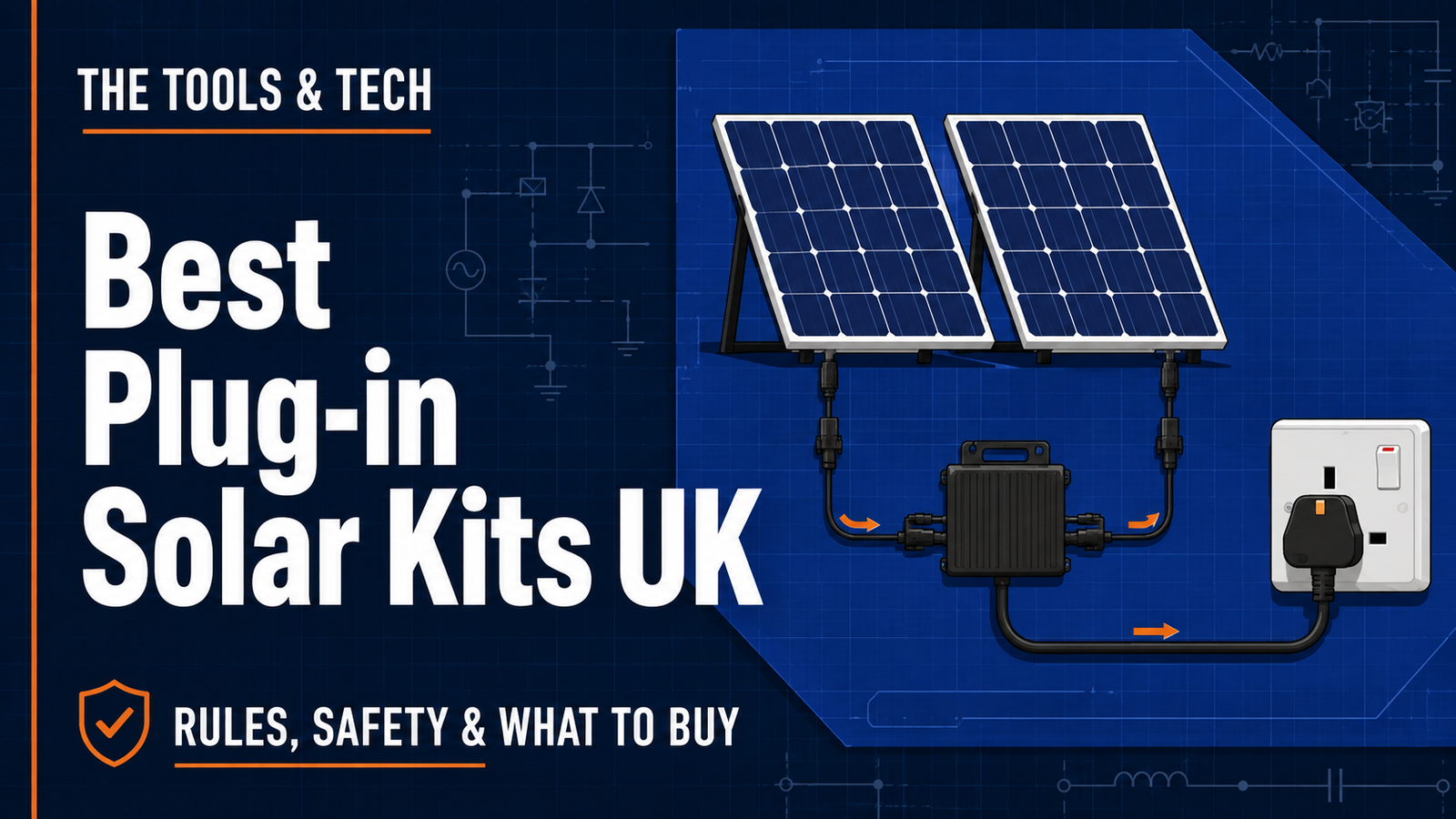
Plug-in solar became a legal consumer option in England, Scotland and Wales on 27 August 2026, but this is a tightly controlled product category rather than permission to connect any panel and microinverter to a household socket. The exact complete system must appear as compliant on the live ENA Connect Direct Plug-in Solar register, the installation must follow its instructions, and the owner must register it after installation. Energy Saving Trust says plug-in solar is not currently permitted in Northern Ireland.
This guide is an early-market, research-based assessment. The Tools and Tech has not hands-on tested these kits, measured their output or verified a household payback. We checked government material, consumer-safety guidance, the compliance route, current manufacturer listings and independent launch coverage. Prices, availability, compliance status and instructions can change, so every buyer must repeat the live checks before ordering.
Only two products in this shortlist were publicly on sale when this guide was checked: UKSOL’s Compact 460W and Duo 890W ground-mount kits. Four hybrid-mount variants were announced for 1 October 2026. They are included to help readers decide whether to buy now or wait, but they are not final recommendations and their prices were not yet verified.
Quick answer
At a glance
| Option | Best for | Why it stands out | Main trade-off |
|---|---|---|---|
| UKSOL Plug-In Solar Pro Compact 460W Ground Mount Kit | A smaller suitable ground space and the lowest launch price | Best lower-cost launch kit: one 460W panel with an 800W-capped microinverter, ground stand, cable and monitoring as an exact system | Ground mount only; ballast is not included and the stand is not approved for balconies |
| UKSOL Plug-In Solar Pro Duo 890W Ground Mount Kit | A household with space for two panels and useful daytime electricity demand | Best higher-generation launch kit: two panels provide 890W of rated capacity while the compliant AC output remains capped at 800W | Costs more, occupies more space and still requires the specified ballast and a suitable socket circuit |
| UKSOL Plug-In Solar Pro Compact 515W Hybrid Mount Kit | Buyers who can wait for a smaller ground-or-wall option | Upcoming compact hybrid: the announced mount should add flexibility once the final product is available and checked | Not on sale when checked; price, final instructions and real-world evidence are not established |
| UKSOL Plug-In Solar Pro Duo 890W Hybrid Mount Kit | Two-panel buyers who need an approved alternative to the launch ground frame | Upcoming balanced hybrid: retains the two-panel format with a planned ground-or-wall mounting system | A compliant kit does not automatically make a balcony, wall or rented property suitable |
| UKSOL Plug-In Solar Pro Plus 1030W Hybrid Mount Kit | A carefully assessed site where additional panel capacity may help in variable light | Upcoming higher-input option: extra DC capacity may extend useful generation away from peak sun | AC output remains capped at 800W and current guidance recommends electrical advice above 960W of panels |
| UKSOL Plug-In Solar Pro Max 1260W Hybrid Mount Kit | Experienced buyers with enough approved space and a justified daytime load | Upcoming maximum-input option: the largest announced panel total in the range | Largest footprint and uncertain value; it cannot deliver more than the permitted 800W AC maximum |
Best lower-cost launch kit: UKSOL Plug-In Solar Pro Compact 460W Ground Mount Kit
Best lower-cost launch kit
UKSOL Plug-In Solar Pro Compact 460W Ground Mount Kit
Indicative price: £849 at launch; checked 27 August 2026
Early or evolving evidence · sources checked 27 August 2026
A complete single-panel launch system with a 460W panel, an 800W-capped smart microinverter, ground stand, 4m AC cable and app monitoring. It is a simpler starting point than the two-panel kit, but output still depends heavily on orientation, shade and daytime use.
Best for: A smaller ground space and the lowest upfront cost in the on-sale launch pair
Potential drawback: Ground mount only, not suitable for balconies, and ballast is not included
Research assessment
The Compact is the more approachable of UKSOL's two on-sale launch kits: one 460W panel, an 800W-capped smart microinverter, ground stand, cable and app monitoring in a complete listed system. Its lower purchase cost and smaller footprint are useful, but £849 is still substantial for modest generation and the included stand is explicitly not for balconies. Treat ENA reference UKSOL/21002/V1/A2, the supplied ballast instructions, cable reach and a suitable permanent socket as purchase-critical checks rather than assuming every garden or flat is suitable.
- Complete on-sale launch kit with the lowest price and smallest panel count in the current UKSOL ground range
- App monitoring and a compliant 800W-capped microinverter are included as part of the exact system
- Ground mount only, not suitable for balconies, and the buyer must supply and correctly use the specified ballast
- Savings depend on unshaded orientation and daytime self-consumption; it is not battery storage or backup power
Sources and evidence notes (4)
This editorial synthesis does not represent a hands-on test by The Tools and Tech. Source links are references, not affiliate links. Research depth: Exact official kit and launch price, named compliance reference, independent legal and suitability guidance; no mature long-term product testing yet.
- UKSOL Compact 460W official store listing (opens in a new tab) (manufacturer and current retail information)
- Solar Energy UK compliance announcement (opens in a new tab) (industry compliance evidence)
- Energy Saving Trust plug-in solar checklist (opens in a new tab) (independent consumer and safety guidance)
- Which? plug-in solar buying guide (opens in a new tab) (independent buyer guidance)
Price and availability can change. Check the retailer for the latest information.
The Compact was listed at £849 when checked on 27 August 2026. Its complete system combines one 460W panel, an 800W-capped smart microinverter, a ground stand, a 4m AC cable and app monitoring. The smaller panel count makes it the more approachable of the two on-sale launch choices, but the purchase still needs to be justified against the household’s unshaded space and daytime electricity use.
Its key limitation is placement. UKSOL explicitly describes the launch frame as a ground stand, not a balcony mount, and says ballast is not supplied. The buyer must follow the exact ballast and installation requirements rather than improvising a frame or fixing. Cable reach, outdoor exposure, wind, shade, children, pets and the route to a suitable permanent socket all matter before purchase.
This is an early research assessment, not a measured performance review. The Tools and Tech has not confirmed generation, app quality, installation time or long-term reliability. Check that the complete product and reference UKSOL/21002/V1/A2 still appear as compliant in the live ENA route before buying; a model name on an old article is not enough.
Best higher-generation launch kit: UKSOL Plug-In Solar Pro Duo 890W Ground Mount Kit
Best higher-generation launch kit
UKSOL Plug-In Solar Pro Duo 890W Ground Mount Kit
Indicative price: £1,199 at launch; checked 27 August 2026
Early or evolving evidence · sources checked 27 August 2026
The on-sale two-panel system combines 890W of rated panel capacity with an 800W-capped smart microinverter, ground mounting, 4m cable and app monitoring. Extra panel capacity can help in less-than-perfect light, but it needs more safe, unshaded space and suitable ballast.
Best for: Households with ground space for two panels and meaningful daytime electricity use
Potential drawback: Larger, heavier and costlier while the AC output remains capped at 800W
Research assessment
The Duo uses two 445W panels feeding an 800W-capped microinverter, so it can make better use of mixed light than the single-panel launch kit without exceeding the legal AC limit. It is the stronger generation candidate for a household with suitable unshaded ground space and regular daytime demand. The trade-off is a £1,199 launch price, two large panels, more ballast and handling, and no automatic payment for surplus export. Recheck ENA reference UKSOL/21003/V1/A2 and the complete delivered kit before installation.
- Two-panel 890W DC design can reach useful output more often than the single-panel option in variable conditions
- Complete current retail kit includes the matched 800W microinverter, ground frame, cable and monitoring
- Requires substantially more safe ground area, handling and ballast while output to the socket remains capped at 800W
- The higher upfront price only makes sense where orientation and daytime electricity use support realistic savings
Sources and evidence notes (4)
This editorial synthesis does not represent a hands-on test by The Tools and Tech. Source links are references, not affiliate links. Research depth: Exact official kit and launch price, live-register route and independent suitability guidance; no mature seasonal or durability evidence yet.
- UKSOL Duo 890W ground-mount official store listing (opens in a new tab) (manufacturer and current retail information)
- ENA Connect Direct Type Test Register (opens in a new tab) (official live compliance register)
- Energy Saving Trust plug-in solar checklist (opens in a new tab) (independent consumer and safety guidance)
- Which? plug-in solar buying guide (opens in a new tab) (independent buyer guidance)
Price and availability can change. Check the retailer for the latest information.
The Duo was listed at £1,089 with UK mainland delivery when rechecked on 4 September 2026. It uses two panels with 890W of combined rated capacity and an inverter capped at the regulated 800W AC output. The extra panel capacity is intended to help the system produce useful power across a wider portion of the day or in imperfect conditions; it does not allow the socket connection to exceed 800W.
The trade-off is a larger and heavier installation, higher upfront cost and more demanding site planning. A household that is empty during daylight may export more of the generation without payment, while a home with a steady daytime base load may use more on site. The app can show generation, but a buyer still needs consumption data to estimate likely self-use rather than treating panel wattage as a saving forecast.
This launch version is also ground-mount only and needs the specified ballast. Confirm the live ENA status for the exact complete system and reference UKSOL/21003/V1/A2, not merely the brand, panel or inverter separately. The Tools and Tech has not independently measured its output or payback.
Should you wait for the Compact 515W or Duo 890W hybrid kits?
UKSOL announced Compact 515W and Duo 890W hybrid-mount systems for 1 October 2026. The attraction is an installation method intended for ground or wall use rather than the ground-only launch stands. That could make the range relevant to more properties, but ‘hybrid mount’ should not be read as blanket approval for a balcony, façade, roof or high-rise building.
At the review date these were upcoming products. Prices, retail contents, final instructions, warranties and independent performance evidence were not yet established. Their compliance entries should be checked again when the exact retail kits are available. Before fixing anything to a wall, buyers should resolve ownership, landlord or freeholder consent, planning rules, building safety, fire risk, wind loading and insurance requirements.
Wait if the current ground stand does not suit the property. Do not buy a ground kit and improvise a wall or balcony mounting method. A correctly listed system can still be unsuitable for a particular building or installation location.
What the Plus 1030W and Max 1260W systems are trying to do
The announced Plus and Max kits pair more than 800W of panel capacity with an AC output that remains capped at 800W. This is not a loophole for higher socket output. Oversizing the panel side can help an inverter reach useful output more often in low or variable light, but peak production is clipped and the extra panels add cost, size, weight and mounting exposure.
Energy Saving Trust’s launch checklist advises speaking to a qualified electrician when the panels total more than 960W. That makes the Plus 1030W and Max 1260W poor impulse purchases. They need a site-specific comparison of shading, orientation, daytime load, cable route, circuit condition, space and expected extra generation versus the smaller kits.
Both remain upcoming options rather than tested recommendations. The correct editorial treatment is to explain the design choice and the extra checks, then revisit price, availability and evidence after release.
Seven checks before buying plug-in solar
1. Verify the exact complete kit
Check the live ENA Connect Direct Plug-in Solar register immediately before purchase. Compliance applies to the exact complete system, not a brand in general and not a do-it-yourself combination of a panel, cable and inverter. Do not swap parts, alter the plug, daisy-chain systems or assume an imported balcony kit is legal because it looks similar.
2. Confirm the rules where you live
The launch framework covers England, Scotland and Wales. Energy Saving Trust says plug-in solar is not currently permitted in Northern Ireland. Property permission is separate from electrical product compliance: tenants, leaseholders and flat owners may need approval from a landlord, freeholder, managing agent or insurer, and planning or building-safety controls can still apply.
3. Check the permanent socket and circuit
The kit must plug directly into a suitable permanent socket. Do not use an extension lead, travel adaptor, multiway block or altered connection. Energy Saving Trust advises an IP65 outdoor socket installed by a registered electrician when an outdoor connection is needed, warns against use on an older rewireable-fuse installation, and recommends electrical advice when panel capacity exceeds 960W. Follow the exact product instructions and obtain professional advice if the circuit or socket is uncertain.
4. Treat mounting as a safety decision
A panel is a large wind-exposed object. Use only the mounting method and ballast specified for the exact kit. The two on-sale launch products are ground systems and are not approved balcony products. Do not infer that an announced wall-capable system will suit every wall, balcony or high-rise: structure, wind, fire, access and falling-object risk remain property-specific.
5. Model self-consumption, not headline wattage
The most valuable electricity is usually the generation the home uses while it is being produced. Review smart-meter or appliance data to estimate a daytime base load, then consider orientation and shade. Government material describes a possible annual saving of up to £110, but that is an estimate rather than a promise. Calculate a cautious range using the purchase cost, local generation assumptions, self-use and the current electricity tariff; do not present a single payback date as certain.
6. Register the installation
Under the current process, one compliant plug-in solar device is allowed per property and the installation must be registered after it is installed. Follow the official registration route and keep the product reference, serial information, receipt and installation record. Registration is not a substitute for permission or safe installation.
7. Understand what it does not do
A standard plug-in solar kit is not a power-cut backup: compliant inverters stop exporting when the grid fails. Batteries are outside the initial plug-in solar framework unless a complete battery-inclusive system is expressly accepted under a future route. Do not attach a generic plug-in battery, and do not assume exported power will earn a tariff. Check warranty terms, app data handling and ongoing support as well as the hardware.
How we researched this guide
We treated electrical compliance and installation safety as mandatory filters before price, panel capacity or commercial availability. The primary checks were the UK Government launch material, Energy Saving Trust’s consumer checklist, the ENA compliance route and the manufacturer’s exact product information.
We separated products that were on sale from products that were only announced, recorded prices only with a date, and did not create star ratings, guaranteed savings or hands-on claims. Independent launch coverage was used to cross-check the market context rather than to replace the live official register.
Before buying, open the current official sources and verify the ENA status and instructions for the exact system, plus current availability and price. This guide should be rechecked whenever the legal framework, register, safety guidance or product range changes.
Frequently asked questions
Are plug-in solar panels legal in the UK?
Exact compliant systems became legal in England, Scotland and Wales on 27 August 2026 under the new framework. Energy Saving Trust says they are not currently permitted in Northern Ireland. Generic or self-assembled plug-in systems are not made legal by the change.
Can I plug a solar panel into an extension lead?
No. Current consumer guidance requires a direct connection to a suitable permanent socket and says not to use extension leads, adaptors or multiway sockets. Use a registered electrician for a suitable outdoor socket when needed.
Can I install one on a balcony?
Do not assume so. The two UKSOL launch kits in this guide use ground stands that the manufacturer says are not balcony mounts. Future wall-capable kits still require the exact mounting instructions and all relevant landlord, freeholder, planning, fire, wind and building-safety approvals.
Do I need an electrician?
A compliant kit may be consumer-installed when the property and permanent socket meet its instructions, but uncertainty about the circuit or socket should be referred to a qualified electrician. Current guidance specifically recommends professional advice for older rewireable-fuse systems and panel totals above 960W, and an electrician should install any required outdoor socket.
Will plug-in solar work during a power cut?
No. Grid-connected microinverters use anti-islanding protection and shut down when the grid fails. These launch kits are not home backup systems.
Can I add a plug-in battery?
Not under the initial plug-in solar framework. Do not add a generic battery or mix components. Recheck official guidance if a future exact battery-inclusive system is accepted.
How much could I save?
It depends on the site, shade, orientation, generation, household daytime use and tariff. The government cited an illustrative maximum of up to £110 a year, not a guaranteed result. Use cautious assumptions and actual consumption data before buying.
Primary sources reviewed
- UK Government: plug-in solar legal framework announcement (opens in a new tab)
- UK Government: consultation outcome and safety framework (opens in a new tab)
- Energy Saving Trust: plug-in solar panel checklist (opens in a new tab)
- ENA Connect Direct: official plug-in solar route and register (opens in a new tab)
- Which?: plug-in solar panels buying and safety guide (opens in a new tab)
- Solar Energy UK: launch explanation and compliant product references (opens in a new tab)
- UKSOL Compact 460W official store listing (opens in a new tab)
- UKSOL Duo 890W official store listing (opens in a new tab)
- UKSOL announced plug-in solar range (opens in a new tab)
Final verdict
Plug-in solar is now a legitimate but tightly regulated option for suitable homes in Great Britain. The Compact 460W is the simpler lower-cost launch choice and the Duo 890W is the stronger candidate where two panels, safe ground space and daytime demand make sense. Everyone else should wait rather than improvise: buy only an exact complete system that remains compliant on the live ENA register, resolve property and electrical requirements first, and treat every saving figure as an estimate.